For local marketers, agencies & SEO operators
The Quiet Local SEO Shift That’s Leaving “Good” Marketers Behind
If you’re still relying on a handful of “perfect” pages, you’re watching competitors win by volume—silently, consistently, and at scale.
Part 1 — The Risk You Don’t See (Until Rankings Vanish)
Here’s the ugly truth: local rankings don’t disappear with a dramatic warning. They leak. One map pack slot here, a service page there,
a “near me” term you used to own… and suddenly your lead flow feels like a faucet turned halfway off.
And the scariest part? You can do everything “right” and still lose. Because while you’re polishing one page to perfection, someone else is
quietly blanketing your service area with dozens (sometimes hundreds) of tightly-optimized pages—each targeting a specific location, modifier,
and long-tail intent.
If you’ve felt that creeping pressure—more competitors, more volatility, more effort for the same results—there’s a path forward.
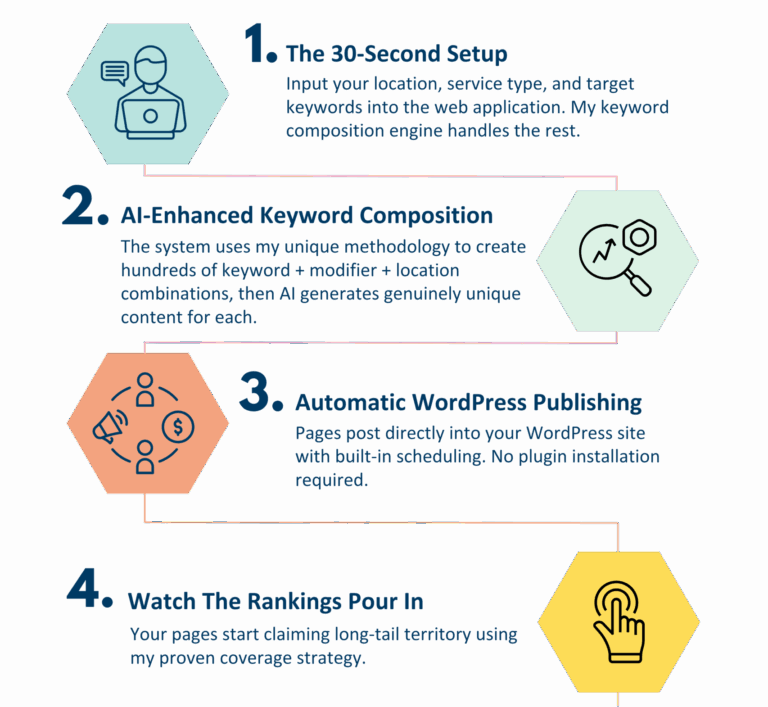
It’s not “more content.” It’s smarter content deployment: coverage-first, built on a proven keyword composition method that turns local intent
into scalable page architecture.
Part 2 — The Insider Advantage: Coverage Beats Perfection (And Always Has)
Most local marketers are still playing a 2016 game with 2026 rules. They obsess over a small set of “money pages,” then wonder why a competitor
with fewer backlinks—and sometimes a weaker brand—starts outranking them across the map.
The advantage isn’t magic. It’s a system. A specific way of composing keywords that combines:
service + modifier + location targeting at scale, so Google has more entry points to match real searches.
What the mainstream crowd misses
Here’s what you rarely hear said out loud: Google doesn’t reward “one perfect page” when search behavior is fragmented.
Local queries are messy—people add neighborhoods, suburbs, landmarks, urgency words, and odd phrases that never show up in the obvious tools.
If you’re not present on those long tails, you’re invisible to the easiest wins.
- Local search is a coverage game. The sites that dominate often have hundreds of tightly-aligned pages that match micro-intents.
- Modifiers are multipliers. “Emergency,” “same-day,” “affordable,” “best,” and “near me” change intent—and ranking behavior.
- Location targeting is fractal. City → suburb → neighborhood → landmark. Each layer unlocks more entry points.
- Speed matters now. When competitors can generate pages in minutes, your “manual” workflow becomes a bottleneck.
A while back, a particular approach to keyword composition proved something controversial:
you can create a flood of highly-relevant pages without turning them into low-quality spam—if the structure is built correctly.
The pages are not random. They’re mapped. They’re organized. They’re designed to match how people actually search for local services.
Recently, I saw a case study that stopped me cold: a local business owner ranking for hundreds of long-tail terms using automated
page generation—something like 847 long-tail keywords from a single site buildout. And here’s the twist: he wasn’t even using the
best version of the method.
That’s the part that should make you lean forward. Because if an inferior knockoff can produce real traction, imagine what happens when the
original strategy is rebuilt as a modern web app, upgraded with 2025-level AI assistance, and freed from old platform limitations.
Why this matters to agencies and serious local operators
If you run client SEO, you already know the pain: every new vertical means new research, new page planning, new content assembly, new QA,
new uploads, new internal linking… and then waiting weeks to see if you guessed right.
The breakthrough is collapsing that timeline. What used to take hours becomes minutes. What used to be limited by plugin constraints becomes
a scalable workflow: generate structured page sets, maintain consistency, and deploy a coverage-first architecture that compounds across
service areas.
This is why the old-school pros who remember “real domination” keep gravitating back to one principle:
coverage beats perfection. It always has. Always will.
Part 3 — The Myth That’s Keeping You Stuck
Conventional wisdom says: “Write fewer pages, make them better.” And sure—quality matters. But in local SEO, that advice is incomplete.
It ignores how real demand shows up: scattered across thousands of micro-queries with different intent signals.
If you’re only building a handful of flagship pages, you’re betting your entire local lead engine on a tiny slice of the market.
Meanwhile, the operators who win aren’t doing anything mystical—they’re doing something unfashionable:
building a map of intent and deploying coverage with a repeatable keyword composition system.
Here’s the alternative perspective that actually matches what we see in the field:
the fastest path to more local leads is not “more backlinks” or “more blog posts”—it’s more relevant entry points aligned to
service + modifier + location.
And when you combine that with modern AI assistance—especially for structuring, variation, and consistency—you get the kind of leverage that
turns “one site” into a footprint across an entire region.
If you’re curious how this works (and how marketers are building massive page coverage without drowning in manual work),
you’ll want to see the system behind it. The full breakdown shows the method, the workflow, and what’s been transformed in the modern rebuild.
Note: This page is designed to help you evaluate the strategy and the mechanism. Details and full access are on the next page.